Hey, I'm Thomas. I work on interpretability at Goodfire, as part of the life sciences team. Interpretability is the scienceread dark art of understanding what AI models have learned. These models can solve problems without us fully understanding how they do it. My work starts with a question:
What do AI models know that we don't, and how can we learn from them?
Models think in numbers and geometries; we think in concepts and compositions. My research connects the two by studying the geometric structure of networks and how their parts interact and recombine. My PhD developed the mathematical foundations for this work. Now I'm applying them to open problems in the life sciences.
When I'm not researching, you'll find me on a long bike ride, gaming 
 doing the computer stuff since ...
with friends, skiing, wearing shorts, or some
combination
doing the computer stuff since ...
with friends, skiing, wearing shorts, or some
combination 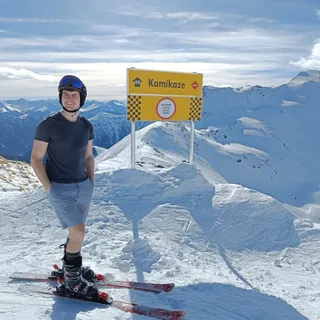 It's a sunny day!
. I used to play a lot of Diablo 3, reaching top-1suck it Elon on the grift leaderboards.
It's a sunny day!
. I used to play a lot of Diablo 3, reaching top-1suck it Elon on the grift leaderboards.
Papers.
Bilinear Autoencoders
An autoencoder architecture that decomposes activations into polynomial manifolds.
Tensor Similarity
A weight-based similarity metric for neural networks, invariant to weight symmetries.
Compositional Interpretability
A category-theoretic framework for formalizing mechanistic explanations of neural networks.
ClinVar Variant Prediction
Predicting and explaining the pathogenicity of 4.2M genomic variants from ClinVar.
Introducing SimpleStories
A synthetic dataset of diverse yet simple stories for training small language models.
Deep Interpretable Models
Scaling up weight-based interpretability from single layers to deep multi-layer models.
Bilinear MLPs
Using bilinear MLPs to reverse-engineer image and language models from their weights.
Tokenized SAEs
Using a per-token bias in SAEs to separate token reconstructions from interesting features.
The Trifecta
Three techniques that improve the forward-forward algorithm, achieving 84% on CIFAR-10.